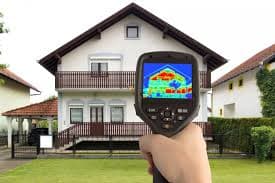
Quick Answer: Thermal imaging uses an infrared camera to detect temperature differences across surfaces. Those differences point to hidden moisture, missing or compressed insulation, air leaks, and electrical hot spots that are invisible to the naked eye. Every Gold Coast Home Services inspection includes thermal imaging at no extra charge.
There's a fair amount of marketing noise around thermal cameras. Some inspectors use them as a gimmick. Others (us included) treat them as one tool inside a larger inspection. The honest answer is this: a thermal camera can't see through walls, but it can show you where to look.
How Thermal Imaging Actually Works
A thermal camera measures infrared energy emitted from surfaces and converts it to a color image. Warmer surfaces show up brighter; cooler ones show up darker. The picture you see is a heat map, not an x-ray.
When something behind a wall is at a different temperature than what's around it, the surface above it will show that. Wet insulation reads colder. A missing batt of insulation reads as a cold strip in winter and a hot strip in summer. An overheating breaker reads as a bright glow inside the panel.
It takes training to read these images correctly. Shadows, sunlight, recently-used appliances, and HVAC airflow can all create false signals. That's why a thermal scan is most useful when paired with a moisture meter and a trained eye.
What Thermal Imaging Finds in Chicago Homes
Here's what we catch during a typical Chicagoland inspection that we'd otherwise miss:
Hidden moisture and active leaks
Water inside a wall doesn't always show outside. A toilet flange that's been weeping for six months, an ice dam from last winter, a leaking shower pan, all of these change the temperature of the drywall around them. The thermal camera points us to the suspect area. The moisture meter confirms what's there.
Missing or compressed insulation
A lot of Chicago homes were built before modern insulation standards. Older homes with knob-and-tube wiring often had insulation removed for safety and never replaced. Thermal imaging shows us exactly where the gaps are. We've found whole wall sections in 1920s bungalows with essentially zero insulation behind the lath.
Air leaks and envelope failures
Cold air pouring in around a baseboard, a recessed light, a window frame, or a fireplace damper shows up clearly on a thermal scan in winter. Air leaks aren't just a comfort issue. They're an energy bill issue, and in some cases a moisture-transport problem that leads to mold.
Electrical hot spots
Inside the service panel, we scan breakers and connections for heat signatures. A breaker that's running hotter than its neighbors is often a loose lug, a failing breaker, or an overloaded circuit. These are real fire risks, and they don't always trip the breaker before they do damage.
Radiant floor heat and ductwork
For homes with radiant floor systems, a thermal scan shows whether the loops are functioning and uniformly heated. For forced-air systems, we can see whether registers are actually pushing the temperature they should.
What Thermal Imaging Can't Do
Two big myths worth clearing up:
It doesn't see through walls. It sees surface temperature. If a wall has been at room temperature for hours and nothing behind it has changed in the last few hours, the camera will show a uniform surface.
It doesn't replace destructive testing. When we find a hot or cold anomaly, the next step is investigation: a moisture meter, an inspection cover, a question to the owner. The thermal camera is the start of the conversation, not the end.
It also doesn't work well in certain conditions:
- Reflective surfaces (glass, polished metal) bounce infrared and read wrong
- Surfaces in direct sunlight read hot regardless of what's behind them
- A home where indoor and outdoor temperatures are nearly equal gives weak signals
That last one is the reason a thermal scan in a mild April week tells you less than the same scan in a January cold snap.
How We Run a Scan
On a typical inspection, the thermal camera is moving the entire time. We scan:
- Every ceiling for roof leaks and missing insulation above
- Every exterior wall, especially in corners and around windows
- Bathrooms, behind toilets, under vanities, around tub surrounds
- The electrical panel and any visible junction boxes
- HVAC registers and returns
- Around water heaters and supply lines
- Crawl space ceilings and basement ceilings below kitchens and bathrooms
When the camera flags something, we follow up. The findings end up in the report with side-by-side photos: visible-light and thermal.
FAQ
Does thermal imaging cost extra? Not at Gold Coast Home Services. It's part of every residential inspection.
Can a thermal scan guarantee there's no mold? No. Thermal imaging finds the moisture conditions that lead to mold. A mold inspection with air sampling is what confirms or rules out active growth.
Why don't I see thermal photos in every report? Because most areas scan clean. We include thermal images when they show something worth flagging. A report full of empty thermal photos is just padding.
What season is best for thermal imaging? Winter and summer, when there's the biggest temperature gradient between inside and outside. Mild spring and fall days give weaker signals.
Related Reading
- Your First Home Inspection
- Mold in Chicago Homes
- Pre-Listing Inspection for Chicago Sellers
- Radon Testing in Illinois and Indiana
Schedule an Inspection
Gold Coast Home Services performs full home inspections, with thermal imaging included, across Chicagoland, Illinois and Indiana. We bring the tools, we bring the training, and we explain what we find in plain language.
Reach out at (312) 358-1200 or tonyldiggs@gmail.com to schedule.